

For Research Use Only. Not for human use.
Ultra Pure Peptides – Research Use Only – Raw Material Sourced from the USA
Sungod Lab’s content is based on scientifically reviewed research and verified biological data, which includes studies from reputable research journals such as PubMed, leading physiological publications, etc.
We highly focus on transparency, responsible interpretations, etc., and we clearly separate the research compounds from approved medical treatment.
All the information presented is scientifically grounded, non-promotional and highlights the known effects and potential risks without any exaggeration.
This content is intended for educational and research purposes and should not be considered for medical advice.
In this blog, we will explain
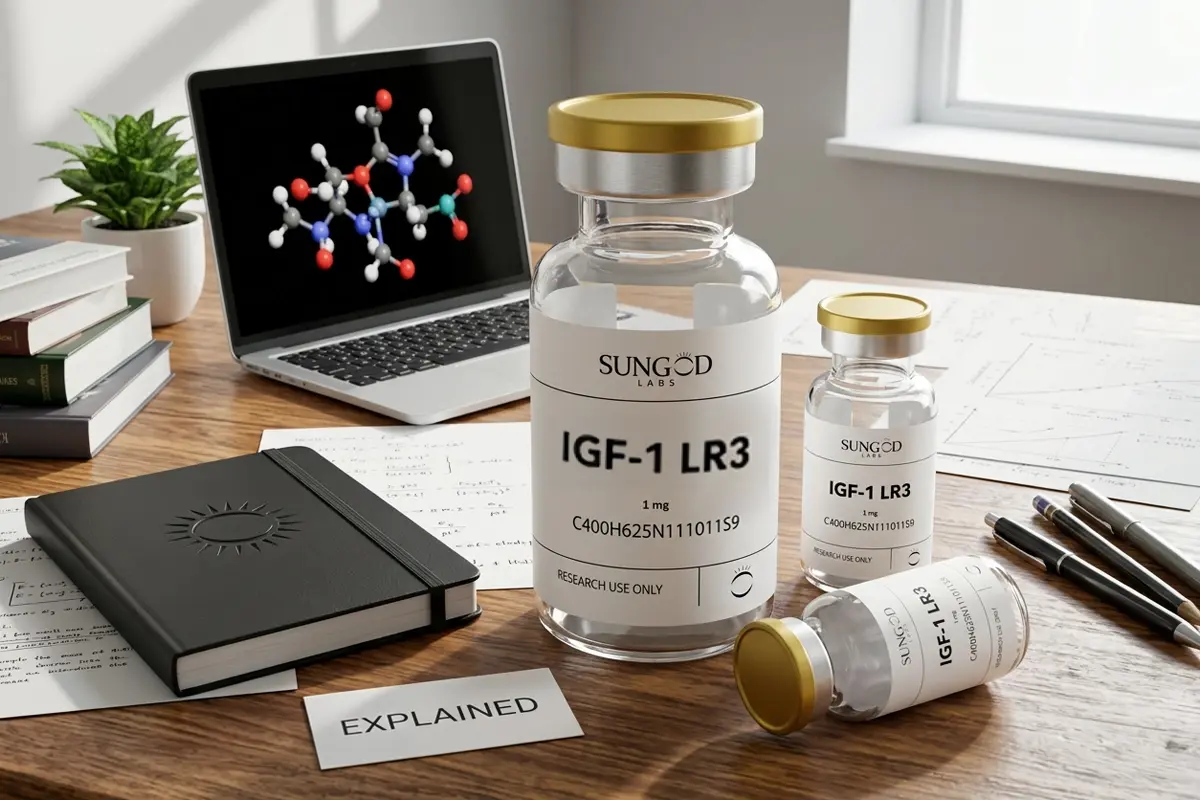
IGF-1 LR3 is a synthetic analog of the human insulin-like growth factor-1. It’s designed to increase tissue repair, fat loss, and muscle strength. It is about 3 times more potent than natural IGF-1 and has a longer shelf life of about 20 to 30 hours.
The Extended Half-Life: IGF-1 LR3 (1mg) has been modified to prevent it from binding with IGF-binding proteins. Which allows it to remain active in the bloodstream for about 20 to 30 hours or longer. In contrast, the natural IGF can remain active for a few minutes only.
Enhanced Muscle Hypertrophy (Anabolism): Once the IGF-1 LR3 is activated, it drives cell proliferation, muscle satellite cells, and overall growth.
Hyperplasia: Instead of increasing the size of already existing muscles (hypertrophy), IGF-1 LR3 will promote hyperplasia and increase the number of muscle fibers.
Reduced Muscle Proteolysis: It will restrict muscle shrinkage and preserve muscle protein, facilitate tissue repair and reduce recovery time.
Nutrient Partitioning and Fat Loss: It increases insulin sensitivity, helps in transporting nutrients into muscle cells and encourages the body to break down fat for energy instead of just storing it.
Muscle Growth and Hyperplasia: Unlike the natural variant of IGF-1, the LR3 causes hyperplasia, which creates new muscle cells in addition to hypertrophy.
Enhanced Muscle Recovery: This will significantly accelerate the repair of muscle tissue, ligaments, and tendons and promote protein synthesis and nitrogen retention.
Improved Fat Metabolism: The igf 1 lr3 1mg will reduce the adipose tissue (body fat) and improve the nutrient uptake optimizing fat metabolism.
Longer Half-Life: The LR3 modification makes the peptide stable instead of natural IGF-1 with a half-life of about 20 to 30 hours, and it also allows sustained anabolic activity.
Anti-Aging and Tissue Repair: This promotes cellular regeneration and improves skin elasticity, and also supports overall tissue health.
Increased Strength: It has a powerful anabolic nature, and can lead to the noticeable increase in strength once combined with consistent resistance training.
| Feature | IGF-1 LR3 | IGF-1 | HGH |
| Type | Synthetic analog | Natural growth factor | Hormone |
| Half-life | ~20–30 hours | Minutes | ~2–3 hours |
| Action | Direct, prolonged receptor activation | Normal physiological role | Stimulates IGF-1 production |
| Muscle effect | Strong in research models | Moderate | Indirect |
| Status | Research use only | Naturally present | Medical use in specific cases |
Cancer Risk: Individuals suffering from cancer or with a history of it should avoid this peptide as it offers growth-stimulating effects.
Metabolic Issues: Individuals with diabetes or insulin resistance should avoid due to risk of hypoglycemia.
Expectant or nursing women: Pregnant women or nursing mothers shouldn’t use this peptide.
Athletes: People in sports or athletes should avoid using it.
The IGF-1R or any other peptide is not suitable for personal use. Always consult a healthcare professional or physician before using this product.
IGF-1 LR3 has gained enough attention for performance-focused discussion and for its extended half-life and role in cellular growth pathways. Research suggests it can influence the muscle development, metabolic activity and recovery process. IGF-1 LR3 is not a therapeutic compound for general use. The long-term safety can remain unclear and unsupervised, and can carry meaningful risks.
https://pmc.ncbi.nlm.nih.gov/articles/PMC7913862/
https://journals.physiology.org/doi/full/10.1152/ajpendo.00259.2024
https://www.frontiersin.org/journals/physiology/articles/10.3389/fphys.2022.954948/full
https://www.frontiersin.org/journals/physiology/articles/10.3389/fphys.2022.954948/full

Dr Parker is a molecular biologist; she specialises in therapeutic and regenerative medicine. With almost 10 years of experience in peptide research, Dr Parker has contributed to research on cellular health and muscle recovery.