
For Research Use Only. Not for human use.
Ultra Pure Peptides – Research Use Only – Raw Material Sourced from the USA
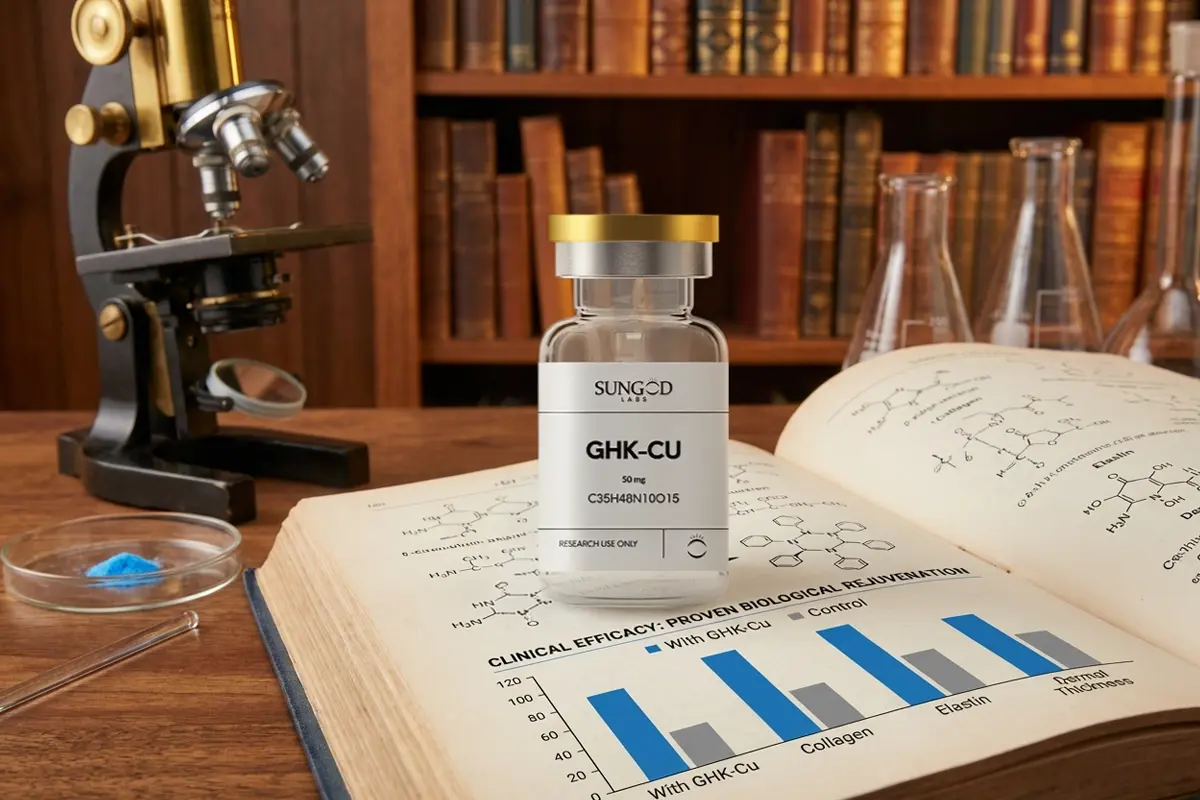
This article summarizes current peer-reviewed research on GHK-Cu (50mg) based on published scientific literature. It does not provide medical advice or clinical recommendations.
This blog was written with careful consideration of healthcare providers, evidence-based practices and researchers. We don’t rely on personal opinion or unsupported claims. Instead, all the information we have shared is derived from the reviewed studies, established scientific literature and clinical research.
The GHK-Cu (50mg) is a high-affinity, copper-binding, and naturally occurring tripeptide commonly found in saliva, human plasma, and urine. It’s often referred to as a copper peptide because it plays a special role in skin remodelling, tissue regeneration and anti-ageing, along with the anti-inflammatory process. Its concentration may decrease with age.
Studies support that GHK-Cu may regulate genes effectively, which resets the damaged cells to a healthier state. It can suppress the genes involved in inflammation and cancer progression.
It also stimulates the genes for DNA repair, antioxidant defence and wound healing.
Copper Delivery (Chelation): The GHK can bind tightly to the copper, which allows for the non-toxic and safe delivery of the cofactor into cells. This also enables the activation of the copper-dependent enzymes like lysyl oxidase, which is highly essential for cross-linking elastin and collagen. This enhances skin fitness and elasticity.
Wound Healing and Remodelling: The GHK-Cu may attract the immune cells to the injury sites, which also promotes the growth of the blood vessels, triggers dermal fibroblast proliferation, and accelerates tissue repair.
This also modulates the metalloproteinases, which break down the old and damaged collagen and stimulate the production of collagen and elastin.
Anti-Inflammatory and Antioxidant Action: The GHK-Cu can reduce the production of anti-inflammatory cytokines, such as IL-6 or TNF-alpha, and may help reduce inflammation by influencing key cellular signaling pathways.
It also acts as an antioxidant by scavenging reactive oxygen species. It inhibits the ion release from ferritin and prevents any lipid peroxidation.
Stem Cell Function: The studies may indicate that GHK-Cu enhances the regenerative capacity of the skin stem cells and increases the expression of the integrins in the keratinocytes. This increases the stemness and proliferative capacity.
Various studies indicate that it increases the hair follicle size and thickness, and also encourages hair growth.
It reduces oxidative stress, protects your skin against UV damage and offers anti-inflammatory properties.
The tissue regeneration: it has the potential to protect the lung tissue from damage and promote nerve health.
Cognitive Support: It has a potential role in reducing inflammation.
The GHK-Cu is researched as an antiaging agent because it’s believed to reset the gene expression ot a healthier and younger state. Current research suggests GHK-Cu is generally well tolerated, but long-term human studies are still limited.
Reduces wrinkles: GHK-Cu improves collagen production, reduces wrinkles and fine lines in about 12 weeks.
Tightens skin: it can reverse the skin thinning and improve the firmness and elasticity. Research suggests it can often perform better than many vitamins.
The photodamage repair: this reduces the hyperpigmentation, mottled skin spots and improves the overall skin.
Barrier Restoration: The GHK-Cu often is believed to repair the skin’s protective barrier; it’s highly suitable for sensitive skin and may reduce any redness or irritation.
ghk cu 50mg is studied in both topical and injectable forms. Any injectable use should be carried out only under the supervision of a qualified healthcare professional.
The peptide is typically reconstituted using sterile or bacteriostatic water. The solution should be added slowly along the side of the vial and gently swirled until fully dissolved. Avoid shaking to maintain peptide stability.
In research peptides and clinical settings, GHK-Cu may be administered via subcutaneous injection using appropriate medical equipment. The exact dosage, frequency, and injection site should always be determined by a licensed healthcare provider.
Once reconstituted, the solution is generally stored in a refrigerator (2–8°C) and kept away from direct light. Proper storage helps maintain stability and effectiveness. Always follow professional guidance for storage duration and handling.
Current studies suggest GHK-Cu is generally well tolerated in experimental and cosmetic applications. However, long-term human safety data remains limited, and mild local reactions have been reported.
Only about 50mg of the vial is used in clinical research, such as through serum or injection. It offers higher concentration for skin and systemic repair. Used under supervision for maximum efficacy.
The GHK-Cu is a naturally occurring peptide that can support skin recovery, tissue damage and scar healing. The optimum dosage is up to 75mg, but one should always start low. The research on whether it should be used for humans is still going on; always consult a healthcare provider before using it.
https://pmc.ncbi.nlm.nih.gov/articles/PMC6073405/
https://www.mdpi.com/1999-4923/15/10/2485
https://www.frontiersin.org/journals/pharmacology/articles/10.3389/fphar.2025.1551843/full
https://www.lidsen.com/journals/geriatrics/geriatrics-02-03-009
Dr Parker is a molecular biologist; she specialises in therapeutic and regenerative medicine. With almost 10 years of experience in peptide research, Dr Parker has contributed to research on cellular health and muscle recovery.