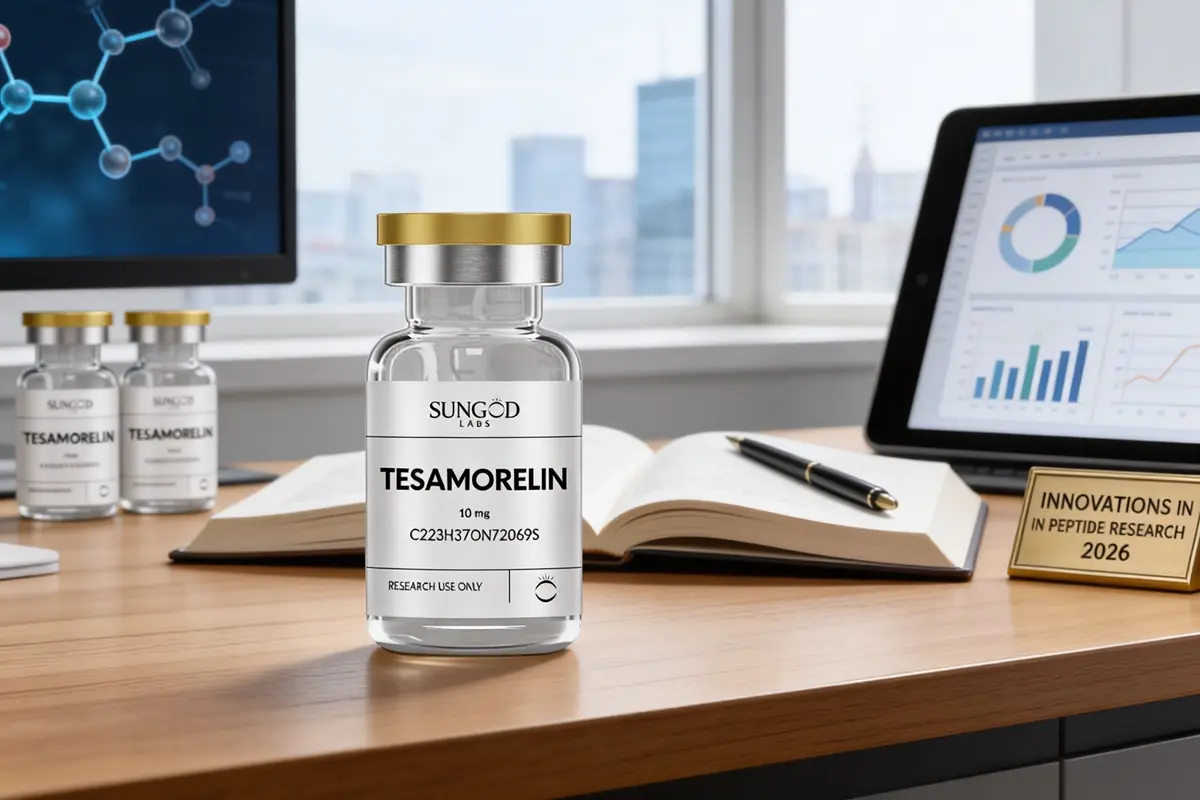

For Research Use Only. Not for human use.
Ultra Pure Peptides – Research Use Only – Raw Material Sourced from the USA
Tesamorelin (10mg) is the most discussed peptide based on therapies for metabolic and endocrinology-related research. The originally developed medical applications are explored while discussing growth hormone regulation, body composition and age-related metabolic concerns.
The interest in peptide science continues to grow even in 2026. Tesamorelin is a highly researched peptide among researchers, communities, and biohacking that explores advanced metabolic therapies.
Interest in peptide science continues to grow even in 2026. Tesamorelin is still a highly researched topic among clinicians, biohacking communities, and researchers who have explored advanced metabolic therapies.
This guide helps us explain what tesamorelin actually is, how it’s FDA-approved, the side effects, and potential benefits. Research findings and safety profiles are highly essential for consideration based on scientific understanding.
Tesamorelin is a synthetic analogue of the growth hormone-releasing hormone, and it was designed to stimulate the pituitary gland and increase the natural production of the release of growth hormone (GH).
Unlike the direct growth hormone injections, the tesamorelin can work by upstream and encourages the body to produce more of its own endogenous growth hormone.
Its only FDA-approved use is the reduction of the excess abdominal visceral fat in various patients living with HIV and associated lipodystrophy. The ongoing research is still investigating its broad metabolic and physiological applications.
At Sungod Labs, we understand that when it comes to peptides like Tesamorelin, accuracy and medical credibility are non-negotiable. Our content is built to meet high standards of scientific integrity and transparency so readers can make informed decisions with confidence.
Here’s how our information is validated:
Tesamorelin mimics the activity of the natural growth hormone-releasing hormone in the hypothalamic pituitary axis.
Once administered, it can bind to the receptors in the pituitary gland and can stimulate the release of growth hormone. This increases the GH and can elevate the insulin-like growth factor (IGF-1) levels.
Growth hormone and IGF-1 influence several metabolic processes, including:
Researchers have believed that tesamorelin effects on visceral adipose tissue are linked to enhanced lipolysis and various altered metabolic signaling.
The researchers focused on the clinical discussion surrounding the Tesamorelin (10mg) and have focused on possible benefits such as:
The strongest evidence supports that tesamorelin is related to its reduction in the abdominal and visceral fat.
This area is a foundation of its approved medical use and a primary reason which is described clinically.
The research has suggested that tesamorelin peptide can help maintain the support of the lean and body composition, along with reducing fat accumulation.
So, unlike the aggressive calorie restriction strategies, the therapies can influence the growth hormone pathway and help preserve the muscle tissue.
Tesamorelin peptide can stimulate the natural GH secretion instead of just replacing the GH directly.
This kind of distinction is essential for the endogenous stimulation and can preserve the physiological hormone rhythm in different individuals.
Many people confuse tesamorelin peptide with direct human growth hormone (HGH) therapy.
However, they function differently.
| Feature | Tesamorelin | Direct HGH Therapy |
| Mechanism | Stimulates natural GH release | Supplies exogenous GH |
| Hormonal Regulation | Uses pituitary signaling | Bypasses pituitary stimulation |
| IGF-1 Impact | Indirect increase | Direct increase through GH exposure |
| Administration | Injection | Injection |
| FDA Approval Context | HIV-associated lipodystrophy | GH deficiency and other conditions |
Tesamorelin works through the natural endocrine signaling pathway, and some of the clinicians consider it to be physiologically aligned compared to the external GH administration.
The tesamorelin peptide has received FDA approval for reducing the visceral belly fat in HIV infected patients.
But various online discussions may involve the off-label interest beyond its approved indications.
Consumers need to understand the distinction between:
The scientific evidence is still strongest for its approved clinical context.
The interest in peptide therapies has expanded significantly over recent years. The current research involves:
Researchers have continued to study how tesamorelin can affect:
The studies have shown that tesamorelin can influence liver fat in various populations. This can be an evolving area for investigations.
The scientists have continued evaluating the long-term hormonal regulation, the IGF response and the endocrine safety.
It’s widely discussed online, but the longevity-focused use remains experimental and lacks long-term evidence.
Tesamorelin is not suitable for everyone, and individuals should seek medical guidance, including people with:
Active cancer
A licensed healthcare provider can determine if the therapy is appropriate or not.
The growing popularity of the peptide compound has raised concerns about counterfeit and low-quality products.
The consumers need to be cautious of:
The medical grade therapies need to be obtained through the legitimate healthcare channels.
From an evidence-based standpoint, the tesamorelin is strongly supported for its FDA-approved indication that involves HIV associated and visceral fat reduction.
The research into broader application remains ongoing as:
The responsible scientific approach can require.
This is a highly balanced perspective that is important for modern peptides and marketplaces.
Tesamorelin is the most recognized peptide therapy in endocrine and metabolic research. Its mechanism for stimulating endogenous growth hormone release has gained substantial interest in various areas that involve the body composition, visceral fat and metabolic health.
Peptide science is evolving in 2026, informed decision-making, medical supervision, and evidence-based research for anyone exploring therapies can influence the hormonal pathway.
https://pmc.ncbi.nlm.nih.gov/articles/PMC8243807/
https://www.sciencedirect.com/science/article/pii/S2260134124003049
https://academic.oup.com/ofid/article/12/Supplement_1/ofae631.633/7988201
https://clinicaltrials.gov/study/NCT07481734
https://journals.plos.org/plosone/article?id=10.1371/journal.pone.0179538



Dr Parker is a molecular biologist; she specialises in therapeutic and regenerative medicine. With almost 10 years of experience in peptide research, Dr Parker has contributed to research on cellular health and muscle recovery.