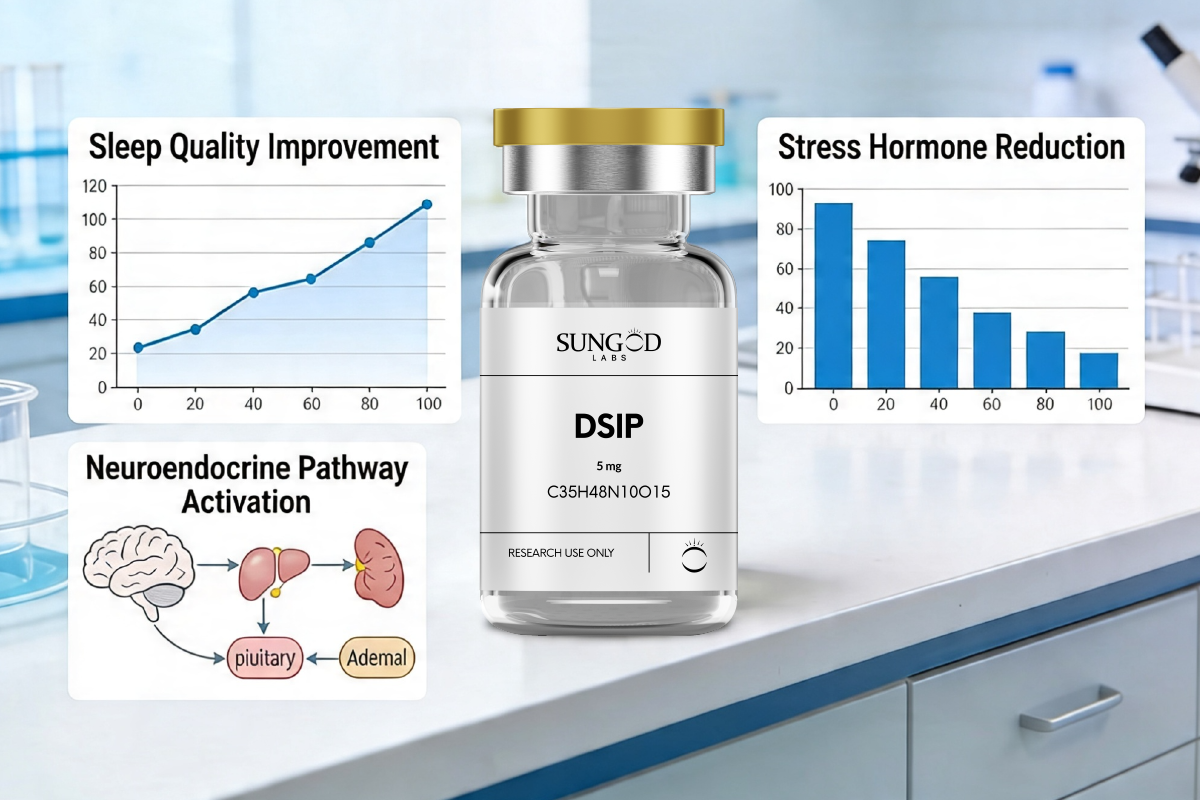

DSIP (5mg) Peptide: Research Insights into Sleep, Stress & Neuroendocrine Function

DSIP (5mg)Current Insights to Sleep Modulation By SunGod Labs

What Is Delta Sleep Inducing Peptide DSIP (5mg)?

Delta Sleep Inducing Peptide (DSIP) is a synthetic research peptide studied for its potential role in regulating sleep patterns, stress response, and neuroendocrine activity. It is typically supplied in a lyophilized form, such as DSIP (5mg), for controlled laboratory research purposes only and is not approved for human consumption.

Current scientific interest in DSIP (5mg) focuses on its possible influence on sleep architecture, particularly slow-wave sleep, as well as its interaction with stress-related hormonal systems such as the hypothalamic–pituitary–adrenal (HPA) axis. However, existing research is still limited, and findings remain preliminary and inconsistent across studies.

Scientific Basis and Editorial Standards

This content is based on currently available scientific literature on Delta Sleep Inducing Peptide dsip peptide including preclinical studies and limited human research. DSIP is an investigational compound, and most findings are derived from animal models.

This article is developed using a structured scientific review process and is aligned with a peer-reviewed delta sleep inducing peptide buy. Content is reviewed for accuracy and clarity by subject-matter contributors who are familiar with peptide research literature.

All information is presented for educational and research purposes only, reflecting the current understanding of DSIP in neuroscience, sleep regulation, and endocrine response.

How Delta Sleep Inducing Peptide Works (Mechanism of Action)

Delta Sleep Inducing Peptide (DSIP) is believed to influence several neurobiological pathways involved in sleep and stress regulation. Although its exact mechanism is not fully understood, research suggests:

  • Modulation of Neurotransmitters: DSIP may interact with GABAergic and serotonergic systems, which play a key role in promoting relaxation and sleep stability.

  • Regulation of the HPA Axis: DSIP appears to influence the hypothalamic–pituitary–adrenal (HPA) axis, potentially reducing cortisol levels and improving stress adaptation.

  • Enhancement of Slow-Wave Sleep: Studies suggest DSIP (5mg) may increase delta wave activity, which is associated with deep, restorative sleep.

  • Opioid System Interaction: Some findings indicate DSIP may interact with opioid receptors, contributing to pain modulation and withdrawal-related effects.

Due to limited and inconsistent findings, these mechanisms remain under ongoing investigation

Key Details About DSIP (5mg)

  • Storage Condition: It’s stored in refrigerated conditions and kept frozen to maintain stability.

  • Research Purpose: This has been primarily studied for promoting deep sleep and can reduce stress-related symptoms.

  • Form and Appearance: It has been supplied for the lyophilised powder, especially in a 5mg vial, which requires reconstitution with sterile water.

What are the Therapeutic Effects of DSIP Peptide

Sleep Regulation & Optimization

The dsip peptide is researched for its capacity to increase the duration of the slow waves and reduce sleep latency.

Chronic Pain Management

Research has suggested that DSIP influences the pain levels, including the conditions of fibromyalgia.

Withdrawal Management

The research has indicated that DSIP can interact with opioid receptors; the studies are exploring the role in alcohol and withdrawal management.

Stress Reduction and Mood Regulation

The studies suggest that DSIP manages stress and reduces the physiological and emotional response. It’s also researched for its ability to reduce anxiety and enhance mood.

Neuroprotective Effects

The preliminary studies suggest that DSIP protects neurons from stress and can point towards possible applications in neurodegenerative disease research.

Regulation of Neurotransmitters

The DSIP is believed to influence the activity of the neurotransmitter and the hormone levels in the brain.

Who Uses DSIP (5mg) in Research?

DSIP (5mg) is primarily used in controlled research environments by:

  • Neuroscientists studying sleep cycles, brain signalling, and neurochemical pathways.

  • Endocrinology researchers investigating hormonal regulation and stress response.

  • Pharmaceutical researchers exploring potential treatments for insomnia, chronic pain, and mood disorders.

  • Academic institutions conducting studies on circadian rhythm and neuroprotection.

  • Biotechnology companies developing peptide-based therapeutic models.

This highlights DSIP’s role as a specialized research compound, not a consumer-grade supplement.

Research Insights on DSIP (5mg)

  • Most DSIP (5mg) research is based on animal studies and limited human trials.

  • Findings on sleep improvement are inconsistent across studies.

  • Potential effects on stress and cortisol require further validation.

  • There is no standardized dosing protocol in clinical research.

  • Long-term safety and efficacy remain uncertain.

Safety and Risks

dsip peptide is not approved for medical use by regulatory authorities such as the FDA or EMA.

  • Limited safety data in humans.

  • No established therapeutic dosage.

  • Potential unknown side effects.

  • Variability in research outcomes.

It should only be handled within controlled laboratory settings.

Conclusion:

The DSIP is a promising and high-research-grade peptide that manages sleep disorders and stress. sleep regulation, stress response, and neuroendocrine function. The existing research is still limited, and the results across various industries remain inconsistent. The evidence is mainly derived from preclinical models. However, there’s no clinical protocol for its use.

References

https://link.springer.com/article/10.1007/s00441-010-1067-4#:~:text=In%20addition%2C%20TR%CE%B12%20has%20been%20shown%20to,other%20TR%20isoforms%20(Koenig%20et%20al.%201989).

https://www.sciencedirect.com/journal/ageing-research-reviews/vol/19/suppl/C

https://journals.lww.com/ejanaesthesiology/fulltext/2001/07000/delta_sleep_inducing_peptide.1.aspx


https://pubmed.ncbi.nlm.nih.gov/15501350/

About Author

Dr. Sarah Parker, PhD

Dr Parker is a molecular biologist; she specialises in therapeutic and regenerative medicine. With almost 10 years of experience in peptide research, Dr Parker has contributed to research on cellular health and muscle recovery.

Frequently Asked Questions

Frequently Asked Questions

What Is DSP (Delta Sleep Inducing Peptide) And What Is Its Proposed Mechanism Of Action?
What Does Current Research Say About DSIP’s Effectiveness In Sleep Modulation?
The limited and clinical studies indicate that DSIP can affect sleep and architecture. Especially the slow-wave sleep. The findings can be inconsistent, large-scale and well-controlled trials.
The studies can suggest that DSIP can modulate the stress response and interact with the (HPA) axis by influencing cortisol levels. These effects have not been validated in the human population.
The key limitations can include small steps, sample sizes, inconsistent reproducibility, and administration methods. Additionally, these methods can be evidence derived from animal models instead of robust human trials.
DSIP can not be approved for regulatory bodies like the FDA or EMA, nor for medical use. It’s also primarily classified as a research compound. Also, its safety in humans is not comprehensively established.